Myth of Horsepower vs Momentum


The Myth of Horsepower vs Momentum Cars
In track driving, we often talk about some cars being "horsepower cars" and others being "momentum cars." The difference is said to change the fastest line around a racetrack. But is that true?
First, some background.
"Horsepower cars" are cars with significant horsepower, such that it's important to straighten corner exits to put down all that power as early as possible.
"Momentum cars" are cars with less horsepower, so they benefit from carrying speed through corners because they don't have the power to regain lost speed quickly.
But where do we draw the line between these two types of cars? And why is there a line?
The myth
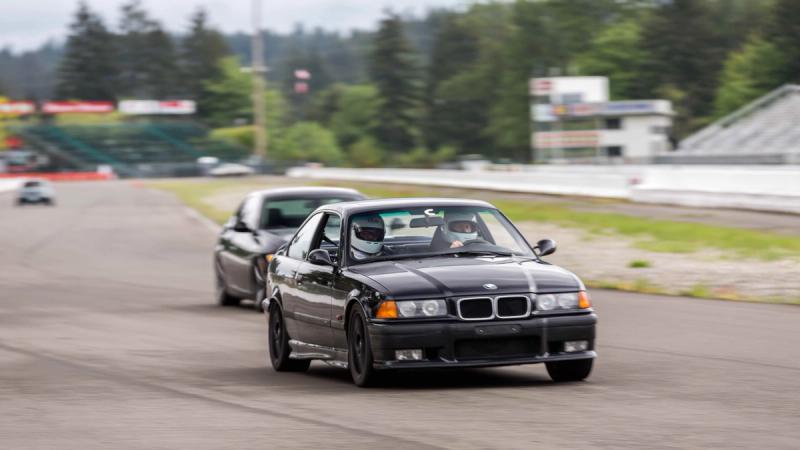
If you ask Dave Cohen, one of our club's Chief Driving Instructors (CDIs) for our High Performance Drivers Education events, which type of car his E36 M3 is, he'll tell you "it used to be a horsepower car, but now it's a momentum car."
What changed? He didn't lower his car's power, nor has it lost that much with age. And the track isn't different. So what did change?
Other cars changed. Horsepower over the years has gone up in new cars. Way up. His 240hp car used to be one of the highest horsepower BMWs on the market, but not anymore.
But that shouldn't change his approach to driving fast, right? The other cars didn't change his car. So what else changed?
His driving skills changed. Driving with less horsepower than the cars around him taught him that he couldn't just rely on his horsepower to be fast anymore. He learned that the real skill of driving fast is in finding an optimal balance between the two approaches. He learned that for really good drivers, there isn't a clear split between horsepower cars and momentum cars.
Balance
Don't get me wrong, all cars are not the same. Optimal driving approaches do vary some by car. But too many drivers oversimplify this balance. And in particular, too many drivers of modern high horsepower cars bias too far towards "horsepower car" driving.
Admittedly, starting out, this is what we teach: straighten corner exits to put down power more effectively. It's the highest impact first lesson for most novices' driving performance in any car.
But at some point, a driver gains enough skill that optimizing every phase of the corner needs to be the goal. More entry speed improves time, more cornering speed improves time, and more exit speed improves time.
However, more speed in one of these generally sacrifices speed in another. So the challenge becomes finding the balance of these trade-offs: how much do we sacrifice in each to add up to the fastest overall time?
As one of my previous articles illustrated, this becomes extra important at the pro level, where judgement of these trade-offs is one of the main skills left to improve. But it is important long before that, it's just more challenging to judge because we still have other skills left to develop, too. So it's worth finding better ways to develop this judgement early.
Optimizing
One of the best ways to improve this judgement is getting a more experienced driver riding in your right seat as a coach, like we have at our High Performance Drivers Education events. You can learn quickly from their experience.
But beyond a certain level, as any good driver will tell you, you need a data acquisition system to compare concrete numbers, too. These measure not just lap times, but all kinds of variables at every point of every lap. Analyzing this data is a skill, in and of itself, so start simple and build up, and get advice from your coach.
Local maxima
That said, be careful of falling into the trap of chasing lap times or data improvements. This often leads to tunnel vision which leads to local maxima. In other words, we can find ourselves perfecting a less effective approach and plateau without understanding why. For example, braking later and later will speed up our lap times to a point, but in practicing this approach we won't realize braking earlier would speed up our times even more. (Plus it's safer, too.)
Practice doesn't make perfect, perfect practice makes perfect.
But none of us are perfect at executing our intents, nor at exploring a variety of intents. So when we're nitpicking details with data, imperfections and missed opportunities often make more difference than the approaches themselves. For this reason, it's often more valuable to focus on exploring diverse skills and approaches, to learn from each.
This is especially true in higher horsepower cars because power can minimize mistakes but it can't eliminate them. Power makes the time difference smaller between a good lap and a weaker lap, making weaknesses harder to spot, and thus harder to improve.
I think this is well illustrated by two examples from one data session of mine against a pro's reference laps:
Mistakes
First up is a corner that is moderate speed and leads onto a fairly short straight. Conventional wisdom is that mid-corner speed is the priority over a strong exit here because the exit speed has only a short straight over which to gain time. So mid-corner speed was a little more my focus.
I compared the data from my fastest laps to the pro's fastest reference lap and identified a pattern: I was consistently 0.2s faster mid-corner, leading the total corner delta to be 0.1s in my favor. His exit and run down the following straight was slightly faster, but not fast enough to beat my approach.
It seemed my momentum bias won out here because of the short straight... until I compared to the pro's second and third fastest laps. It turns out he flubbed this corner on his fastest lap. He did a great job adapting in the moment to minimize the mistake, but it was still a mistake. On his other laps, while I was still consistently 0.1s faster mid-corner, he was using his slightly slower mid-corner to set him up for stronger exits, giving him an overall delta 0.1s in his favor. So it turns out, his slightly more horsepower biased approach was faster in this corner.
This served as an important lesson about how small a mistake it takes to lead to the wrong conclusion. I never would have noticed if I'd been relying on just his fastest lap. Or worse, if I didn't have his data at all, since I'm not nearly as consistent at different approaches as him, I'd have had even less precise reference data. I'd have been led to keep practicing my weaker approach.
The smallest differences can matter, but data analysis can only compare what it has recorded.
Surprises
Don't come to the wrong conclusion here, this doesn't mean that car was just a horsepower car and I was driving it wrong. He was still carrying strong mid-corner speed and I was still getting strong exits, each balancing the trade-offs. He was just balancing in a slightly more horsepower focused way than me. The lesson here is that trade-offs can be surprising and easily misunderstood. And importantly, trade-offs can be surprising in both directions.
Later I was comparing this same reference data for another corner. This is a somewhat tight corner leading onto the long front straight of this track, the definition of where a "horsepower car" should shine with a good exit.
So naturally the pro's intuition told him to maximize that exit at all costs, which he did, putting down all the 523hp of his G80 M3 xDrive for a 2 MPH faster exit than mine. This consistently gained him 0.2s over me down that long straight.
But, counterintuitively, despite his better exit, my bias towards momentum came out ahead this time. He was sacrificing enough mid-corner speed aiming for that absolutely perfect exit that the overall delta was consistently 0.1s in my favor this corner and straight. The interesting thing about long straights is that aerodynamic drag starts to be a limiting factor. Our speeds were the same by the end of that straight, weakening that presumed advantage.
He recognized I'd found a better balance of trade-offs through that corner even before we saw the data, but the data confirmed it; I'd successfully put into practice what I'd learned from him about the importance of finding the right balance between horsepower and momentum in that corner.
Exploration
As you can see, the most critical skill in developing high performance driving is regular, safe exploration. Being flexible to adapt to minimize mistakes, being open to safely experimenting with different ideas, and growing skills to consistently execute a variety of approaches. Fixating on maximizing one approach will only get you so far, even if it looks optimal in the moment, as it tends to lead to local maxima. Practice each deliberately, don't get sloppy, and vary approaches. Fixating on lap times is even worse, because it will encourage you to "try" to drive faster, which is never how fast driving works.
Remember this next time you hear a driver, or even instructor, tell you what the "fastest" approach is. No one is perfect, least of all those who think they know best.
Don't misunderstand, it is critical you listen to your instructors on track, both for your safety and because they're helping you explore different approaches and perspectives. But when you get back to the paddock and have time to think: ask questions, challenge assumptions, and discuss why they're choosing certain approaches and what the trade-offs of those approaches are. And realize, if you're hearing different approaches from different instructors, there are things to learn and to practice from each. It's worth discussing each approach with each instructor.
Always keep finding safe ways to experiment: expanding your limits, hearing different perspectives, and getting good at adapting. High performance driving is a continuous pursuit with no single "best" answer. It doesn't matter what car you drive, the fun is the journey of exploring and learning about all the approaches. And of course the fun of driving our cars the spirited way they were designed to be driven.
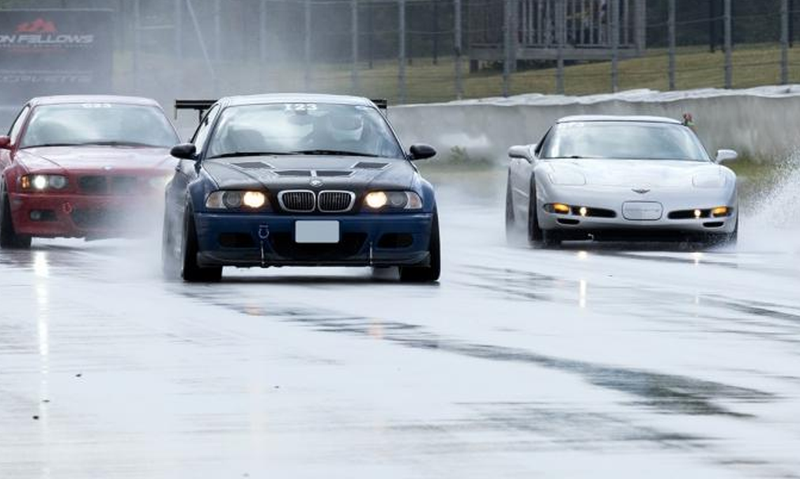
It turns out, rain is a great equalizer between horsepower and momentum approaches, removing much of the advantage of high horsepower cars. It also turns out, this is the PNW where it rains a bit! So don’t be afraid to drive in the rain. You might just learn something new. ~ Editor