The Risk in Unknown Unknowns


The only real mistake is the one from which we learn nothing. Henry Ford
Donald Rumsfeld was famously pilloried by some in the media in 2002 when he stated that in risk decision making, there are “unknown unknowns—the ones we don't know we don't know.” But his statement was sound. I don’t say this to be political, but to leverage a somewhat famous example of the concept I will discuss in this article…being surprised by things we were unaware of in making important decisions that can negatively affected the outcome…the unknown unknowns. I hope others can learn from my mistake.
I am a High Performance Driving Education (HPDE) driver and instructor. I have about eight years of track driving experience. I tend to be pretty conservative in all of my car maintenance and equipment decisions because my background is in the high reliability engineering industry. I thought I had (and still believe I have) excellent risk assessment and decision-making skills. This was my first off-track event in eight years and over 50 track days. So how did it happen? Stay tuned, I’ll tell you.
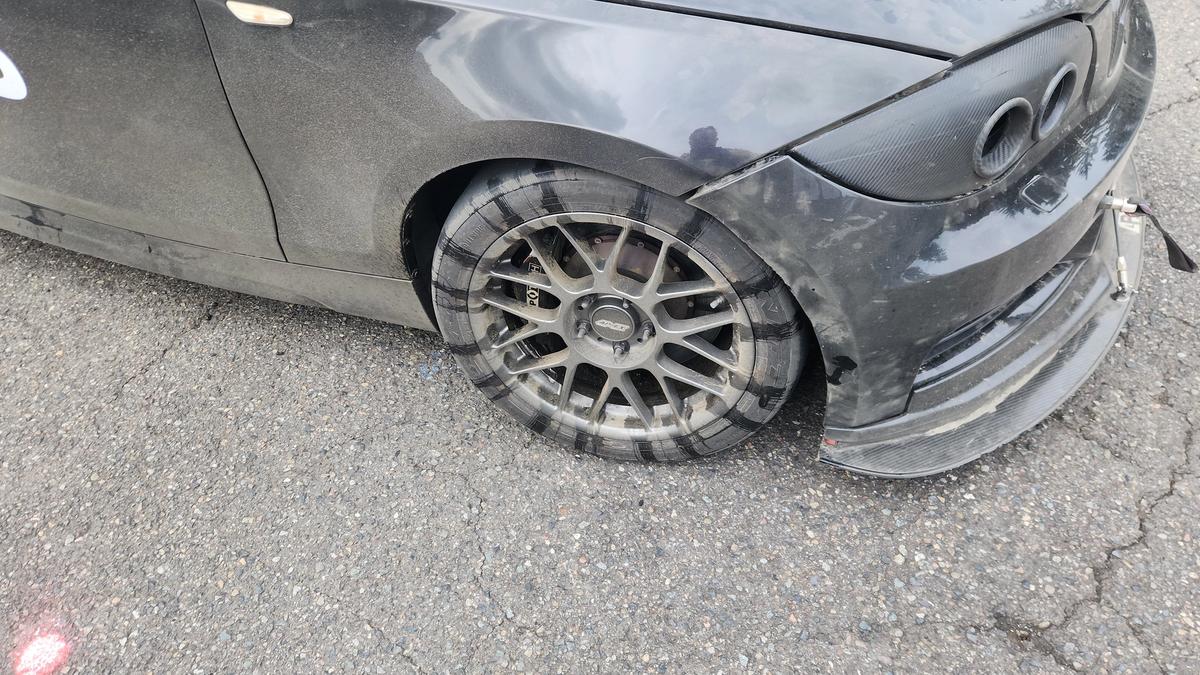
I recently experienced a partial brake failure due to a brake fluid leak in my front passenger side caliper that caused a spin and a slide off the track. Fortunately, once the dust settled (and there was a lot of dust!), me, my friend who was in the passenger seat, and the car were actually all fine. The only thing really damaged was my pride.
When I got back to the paddock it was not clear to me what caused the failure, and I was concerned my expensive aftermarket caliper had somehow had a mechanical failure of some type. I felt I had done everything logically right. I regularly inspected and replaced pads and rotors, did brake fluid changes with racing brake fluid every track season, replacing caliper piston seals every three years, among other things. The only thing I had done differently this track day (the last one of the year) was making what I decided was an acceptable calculated risk to use up my racing brake pads to near zero on the fronts as it was the last track day of the season (and racing brake pads are expensive!).
I started the day at around 25% and knew I typically used 25% on a track day (known known). I was aware pads wore faster when thinner (known known) but really didn’t know how fast (known unknown) because I’d never taken them less than 25%. My safety mitigation plan was to monitor thickness after each session and simply stop driving when they got too thin. My final backstop logic was that even if, in the worst case, I miscalculated and started wearing the pad completely down, I would begin hearing and feeling the metal-to-metal scraping and would pull off the track and be done for the day. I rationalized that I was planning on replacing the rotors this off-season anyway so scraping the rotors wasn’t a concern.
What I didn’t plan for was the unknown unknown (at least to me) – what happens to brake pad backing plates when pad thickness is very low and temperatures are very high. The brake pad backing plate is the metal plate to which the brake pad material is attached. They are typically black steel or galvanized steel. I believed that at the temperatures brake pads experienced on the track, they would not be susceptible to plastic deformation (starting to bend due to being too hot, also called ductility). It turns out I was wrong!
In my forensic analysis of what happened, it quickly became clear that the cause of the brake fluid leak was that the smallest of the three pistons on the inside half of the caliper had begun to deform the brake pad backing plate steel and started to “punch through” the backing plate (see pics). The piston was also melting and starting to make contact with the rotor.
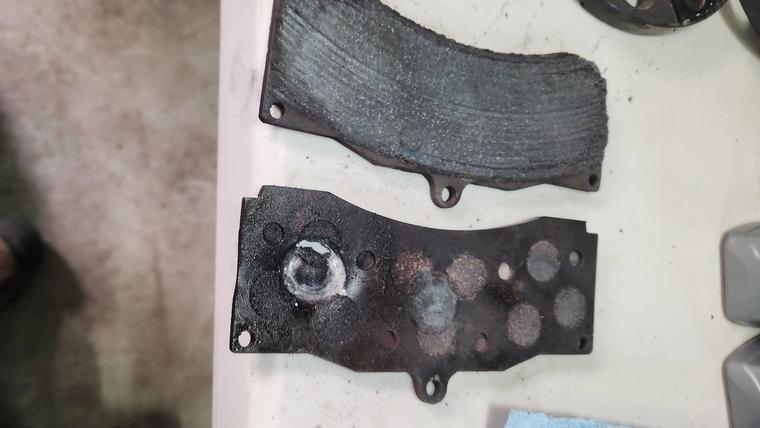
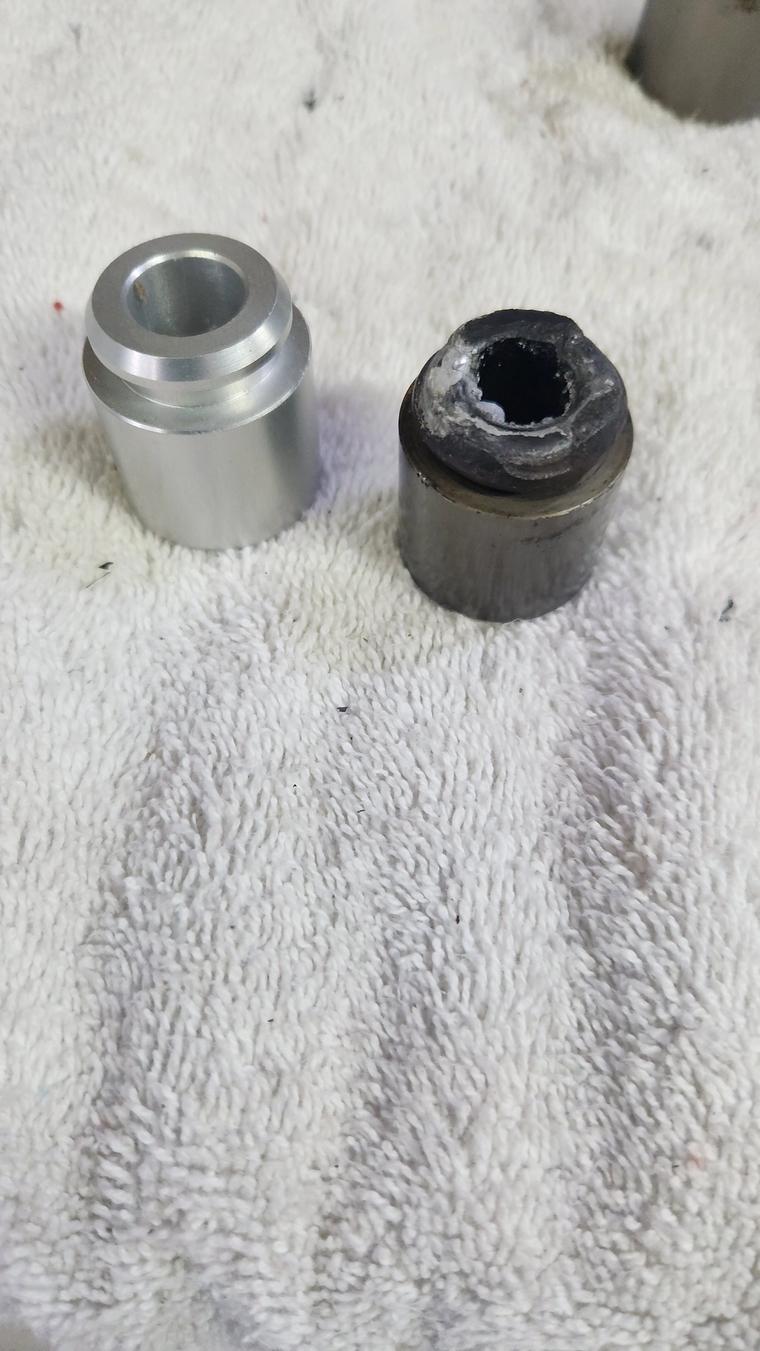
It should be noted that, with the pad material almost completely consumed, even with an uncompromised backing plate, the pistons would be near their design extension limit...but still safe. However, with the ductile failure of the backing plate under the heat of braking and the stress of the piston pushing on it, it enabled the rear of the piston to move past the piston seal and…viola! - significant brake fluid leak and loss of braking function. Thankfully, cars since the 1960s have had dual circuit master cylinders (another thing unknown to me, believe it or not) so that you only lose brake pressure to two wheels if a caliper has a leak. My track car has a diagonal dual circuit master cylinder design, so while I was rapidly pumping the brakes, I actually had two wheels of braking (front left, rear right), which made this track event much less energetic as most of my speed was gone once I left the track.
I decided to do further research on this phenomena. Anecdotally, talking to some friends who have done wheel-to-wheel racing, they confirmed that this can sometimes happen and they had personally observed it. I then researched at what temperature high strength steel starts to deform (I admit I am assuming backing plates are high strength steel). Turns out that temperature is 932F. I have measured rotor temps at the track after a cooldown lap above 750F, so it is clear to me that temps can likely be above 1000F on the pad surface during hard braking. It makes sense that with thin pad material, the heat transfers more readily to the backing plate. This risk of ductility is amplified as the pad material really doesn’t have much structural strength.
So, now, after replacing the piston and seal, what have I learned? That Club rules for pad thickness during pre-track inspections are based on experience, they are not just arbitrary numbers; that I shouldn’t push things, especially safety things, to near limits without fully understanding the effects; and finally, that my own hubris can get me in trouble! (To be honest, I already knew that.) I also decided to add a new mitigator…titanium shims - just a little insurance policy more in line with my typical, conservative decision-making. I am not naïve, I know I will make new mistakes in the future, and this likely won’t be my last off-track experience. But I don’t intend to ever experience this type of brake failure ever again…and I hope this article makes it so that you don’t either!
The only man who makes no mistakes is the man who never does anything. Do not be afraid to make mistakes providing you do not make the same one twice.
Theodore Roosevelt