Car Restoration Made EZ




Do you have too much money and free time, but not enough aggravation and frustration? Then do what I did: restore an old car. Car restoration is the perfect hobby for people who aren’t smart enough to avoid getting stuck in endless expensive projects, people like you. If you’re like me (and I usually am), you’ll need to think long and hard about whether to restore a car or simply spend all your spare time in your garage smashing your fingers on rusted bolts and periodically throwing hundred dollar bills through a sewer grate. Since it’s pretty much a tossup, mull it over only until you spot an old car you simply must have. The best place to see on of these cars is in a magazine that caters to the hobby, such as Cool Old Cars You Will Never Even Get To Sit In, Illustrated in which you will find the object of your lust: the woman in the Black Velvet Whiskey ad. But turning now to the glossy car photos, you see the car of your dreams, immaculately restored, chrome gleaming, paint Shining, with the car’s owner just out of the frame screaming “Aaahhh! I see a FINGER PRINT! Who touched my car?!” and getting spittle all over his straitjacket.
The first step in car restoration is finding a car to restore. The easiest place is your neighbor’s driveway; it’s close and if you get it at night the car will be free. I used this method for my first restoration and now have a mint ’83 Chevette to show for my effort. (WARNING: Taking any car but a Chevette could result in an angry neighbor and/ or prosecution.) But let us suppose that the car of your dreams is, say, a 1957 BMW Isetta Coupe. The best place to find a car such as this is the classified ads (also called “want ads” even though by definition they are listing things people no longer want).
Turn to the classification for “BMW,” or the classification for “Purebred Gerbils,” or the classification for “Help Wanted: Dreamers Completely Out of Touch With Reality”; it doesn’t really matter because you’re never going to find it, and if you did it would be in Florida and cost almost as much. Get real, pal.
Instead, 1 think you should restore the kind of car I did, a 1962 Studebaker Gran Turismo Hawk, for a couple rea sons: 1) It’s a beautiful timeless design with good performance that will turn heads everywhere you go (especially if you choose to repaint it in one of the original color schemes such as Retina Damaging Pink, or Intestinal Infec tion Yellow). 2) After you hopelessly botch your 1962 Studebaker Gran Turismo Hawk, mine will be worth that much more.
The first car restoration skill to acquire is deciphering the old-car-for sale ad. Here is an example ad with the translation in brackets: ’48 Borgward 135 billion original miles. Clean, minimal rust, , all original, , cherry, attracts attention rebuilt engine, good paint and interior needs TLC, . can deliver , $2000/ o.b.o. .
After finding your future dream car, you must skillfully negotiate to get the best possible price because the value of an old car is very subjective and is really only worth what someone is wil ling to pay. Perhaps the following dialogue will offer a constructive example of this traditionally American form of haggling:
OLD CAR OWNER: “.. . and also repacked the wheel bearings every six miles since the car was new using only imported extra virgin olive oil and bees’ wax, and I flossed the radiator every summer, and I always disinfected every passenger before they got in, so I think it’s worth the $3500 I’m asking, especially since it only has 1200 miles on it and was always kept in the den wrapped in shawl.”
ME: “Hmmmm . . . I suppose you thought I would n’t notice that the clock does not work, eh? Not only that, the right rear tire is underinflated. I’ll give you $18.75 for it.”
OLD CAR OWNER : “Sold. I’ll even throw in the Paris-Dakkar Enduro Race trophies it won.”
ME: “And the rodents in the back seat?”
OLD CAR OWNER: “OK.”
The first few days after you bring your car home will see a flurry of activity, most of it caused by your neigh bors building fences to block the aging hulk from their sight. Do not be dis couraged; few fences are so high that you cannot discard useless old car parts over them, and your neighbors will be the first to sing your praises when you finally finish resurrecting your beautiful machine, assuming they are young and in good health when you begin the project.
Before beginning any actual work , you should have a plan , which provides oxygen and pleasing scenery, but will require water and fertilizer. Oops. That’s a plant; I meant you should have a plan, which, when it comes to allocating your limited resources of time and money, is even more worth less than a plant, so don’t bother. Just remember this simple formula: Take your best guess at how m uch some part will cost, then double it; take your best guess at how long a task will take, then triple it. In each case, multiply your final answer by the number of beers you had while making the guesses. Then write your estimates down and save them so at the end of t he project you can see how close you came and laugh and laugh and laugh u ntil tears roll down your face and bead up on your now permanently greasy hands.
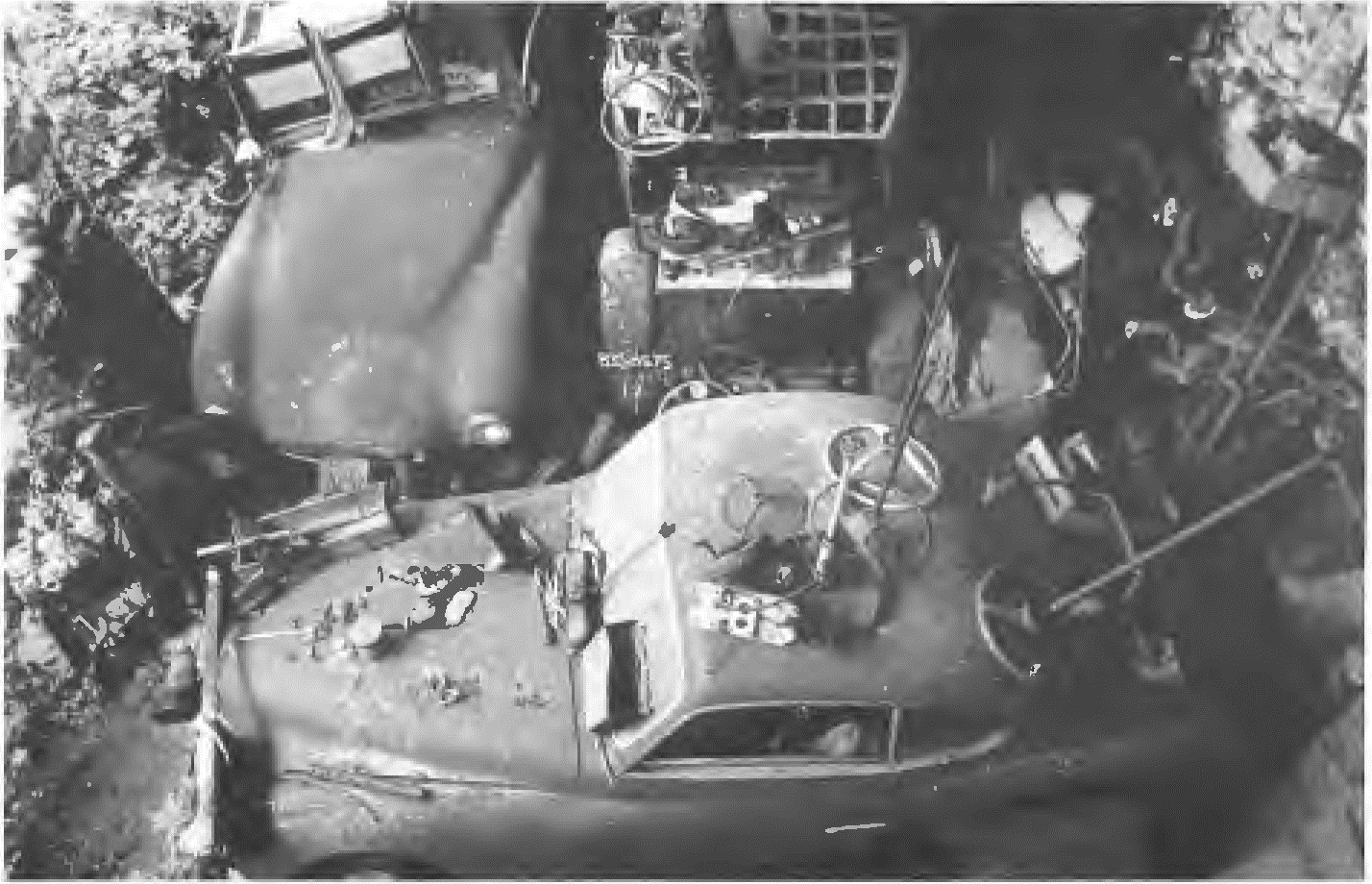
Now it’s time to begin the actual restoration, so roll up your sleeves and perhaps your pant legs and begin tak ing apart the entire car, so that each piece can be painstakingly cleaned, refurbished, and misplaced, taking care to make drawings of complicated things like the engine so that you will be able to put it all back together again. I’ll wait here while you do this . . .
Finished? What you should have now is stripped d own car carcass, ready for body work or hauling to the n e ar es t I nd i a n r e s e r v a t i o n for employ me nt as a lawn ornament. (Hahaha, just kidd ing our Native American bret hren, who I’m sure can take ajoke and would have no desire to trash the next ’62 Studebaker Hawk they see. They make lousy yard deco r a t i o n s a n y w ay – j u s t ask m y neighbors).
What I found to be very hand y for small car pieces was putting them in baggies with slips of paper on which I had scribbled “Pass. door lower sub rocker nut ”, or something equally helpful so that when time came to put everything back together I would not have the faintest notion how.
Before you begin the body refinish ing, you must decide whether to have your car dipped or sanded. Dipping is the process of immersing your car car cass in a vat of strong alkaline solution that eats away all rust . I once had a car dipped and all that came out of the vat were the door hinges and part of, I think, the roof. So you might want to consider sanding you r car body. Buy, rent, or borrow the type of circular sander that spins at approximately 500,000 RPM. I recommend buying because when you’re through with the sander, you can use it (with a few mod ifications) in place of your record player and listen to entire symphonies quicker than you can say “Wow. It threw the tone arm clean through the wall.” Be very careful because if the sanding disk comes off the sander it will zip through the air in some ran dom direction slicing everything in it’s path, even your neigh bor’s dog. This alone is reason enough to buy one. Unfort u nately, these sanders will also go through your car’s old paint , and the sheet metal below, and a few inches of driveway, in the blink of an eye, so use a very light touch; Irecommend plugging the tool in and laying it on the ground no closer than two feet to the car.
Be sure to remember the anecd otes, or “war stories” that happen to you during the course of the restoration. For example, if you spend an entire weekend trying to fabricate a strange little part and keep failing, and you walk to the hardware store so often to get more mate rial t h at the store employees have a pool going as to when your next visit will be, and on your 17th trip you glimpse out of the corner of your strained greasy eyeball a bu bble pack of three of the exact parts you have been trying all weekend to make and it turns out it is a very common hardware store item made in ajillion different sizes, then you should remember this humorous tale and tell it often. Not only will it drive away your few remaining friends, the doctor says it’s therapeutic.
While you are working on the parts of the car that you can handle, you will probably want to have some jobs – painting, upholstery, writing Christ mas cards – performed by a professional. Professionals are easy to find; they have shops whose centerpieces are humorous signs showing several cartoon characters laughing themselves sick atop the words “You Want It When??” You will soon realize this is not a humorous wall hanging as much as it is a life philosophy. If you are visiting the shop of, say, a painter, he will show you a photo album of beauti ful, flawlessly painted cars. If he has been careful, you will see no runs, orange peel, overspray, nor a trace of the magazine these photos were clipped from. After the professional examines your car, which consists of squinting a lot and saying “Hmmmm,” and “Hoo boy,” he may attempt to inject a little levity by saying “Bend over; here comes the estimate .” Fortunately, subcon scious blocking (the same natural mechanism that prevents accident victims from remembering trauma) will probably spare you the pain of ever know ing how much the work will actually cost. Hence, you ‘re not likely to need the nitrous oxide or valium that most states now require automobile professionals to provide . A nd remember: Never ever call the automobile profes sional to see “how it’s comin’ along” as this will annoy them and cause them to stop working on your car and put it back at the bottom of their list.
Many car restorers join clubs dedicated to their particular marque. these clubs can offer resource for parts, tips ‘n’ hints, and – in the Aud i Owners Clu b – legal advice and discounts on convalescent equipment. Unfortunately, many of these clubs get persnickety when it comes to how you intend to restore your car. They don’t think you should paint it a nonstock color, or use any parts that aren’t original factory equipment, or tune the car’s radio to stations founded after t he car was built because it would make the car “impure.” However, concours judges are not allowed to deduct points for any modification that is safety related, so be creative. A furry dashboard, a 200 watt stereo, and seats from a ’70 Dodge can all be construed as safety-related by the clever restorer.
After your car is “done” ( Ha H a! They are never done), which is deter mined by you being out of money and patience, and having lost interest several times, you will want to drive your beautiful old car and show it off. Don’t be a fool. The moment you get out of yo ur d riveway you will be struc k simultaneously on all four sides by uninsured teenagers in sixties muscle cars having no two body panels t he same color. You will not have regular insurance because insurance compan ies no longer cover any car older than the d rivers who have hit you. They used to , but they knew that an old car’s value is subjective and only worth what someone is willing to pay, so they would send a claims adjuster out to look at a client’s totaled 1928 Mercedes SSK and he’d say ”I’ll give yo u $18.75 for it.” Too many claims adjusters with hood ornaments wedged in their throats were filing for disability , so the insurance companies moved on to insuring things like bridges that were seldom totaled by teenagers in cars of mismatched tire sizes, or at least not by fewer than ten of them. So now the old car owner’s only insurance option is the specialty Vintage Auto Insurance policy that places certain restrictions on where and how far you may d rive your classic car, restriction s that you have almost certai nly violated if three of t he four wheels left your driveway .
This article was originally published in the April 1989 edition of Zundfolge